
The mountains of western Montana are sweeping monoliths of beauty and danger, testaments of nature’s grace and ire.
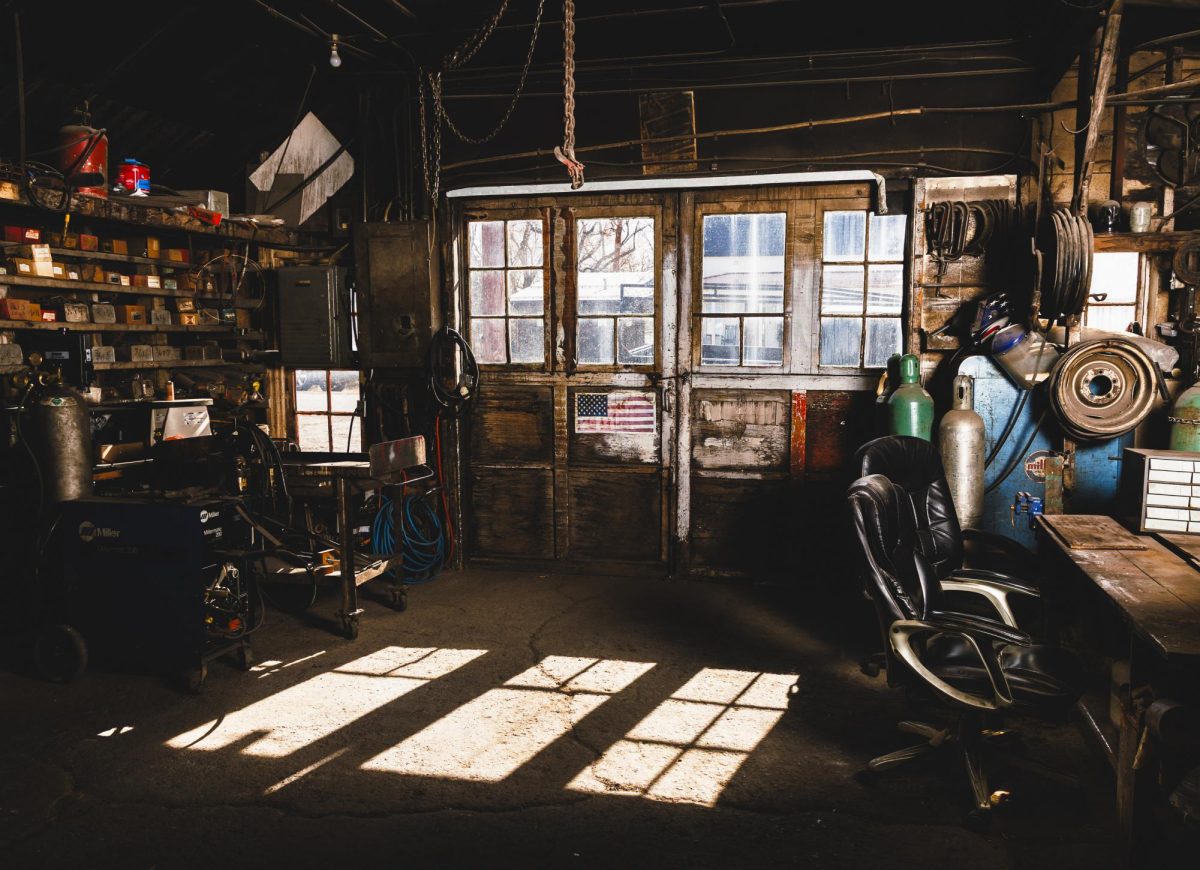
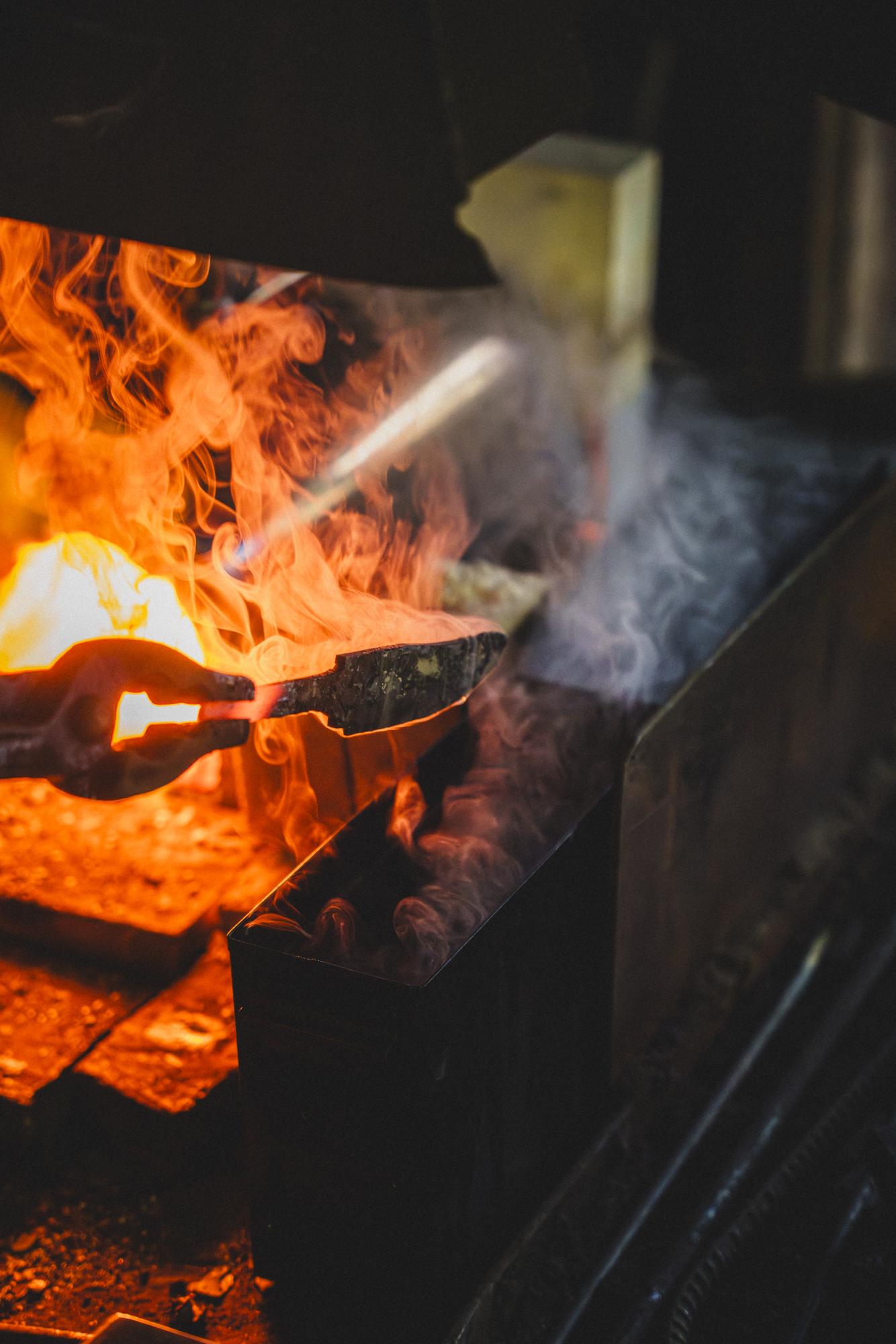
Buried within this granite boneyard is the quiet town of Manhattan, home of the Thronson Forge. This is a place of creation. Inside, sparks dance through the air and fade into the concrete floor. Billets of layered steel are heated until they glow orange, then rhythmically hammered into shape. This forge produces knives, artful blades that could shine on a collector’s mantle or accompany a hunter as they venture deep into the Rockies.
Thronson Forge is owned and operated by brothers Luke and Cole Thronson, men molded by the harsh climates of their Midwest origins and the peaks of their mountain west home. They, in turn, smelt and hammer the ore of their upbringing into tools of deadly resilience.
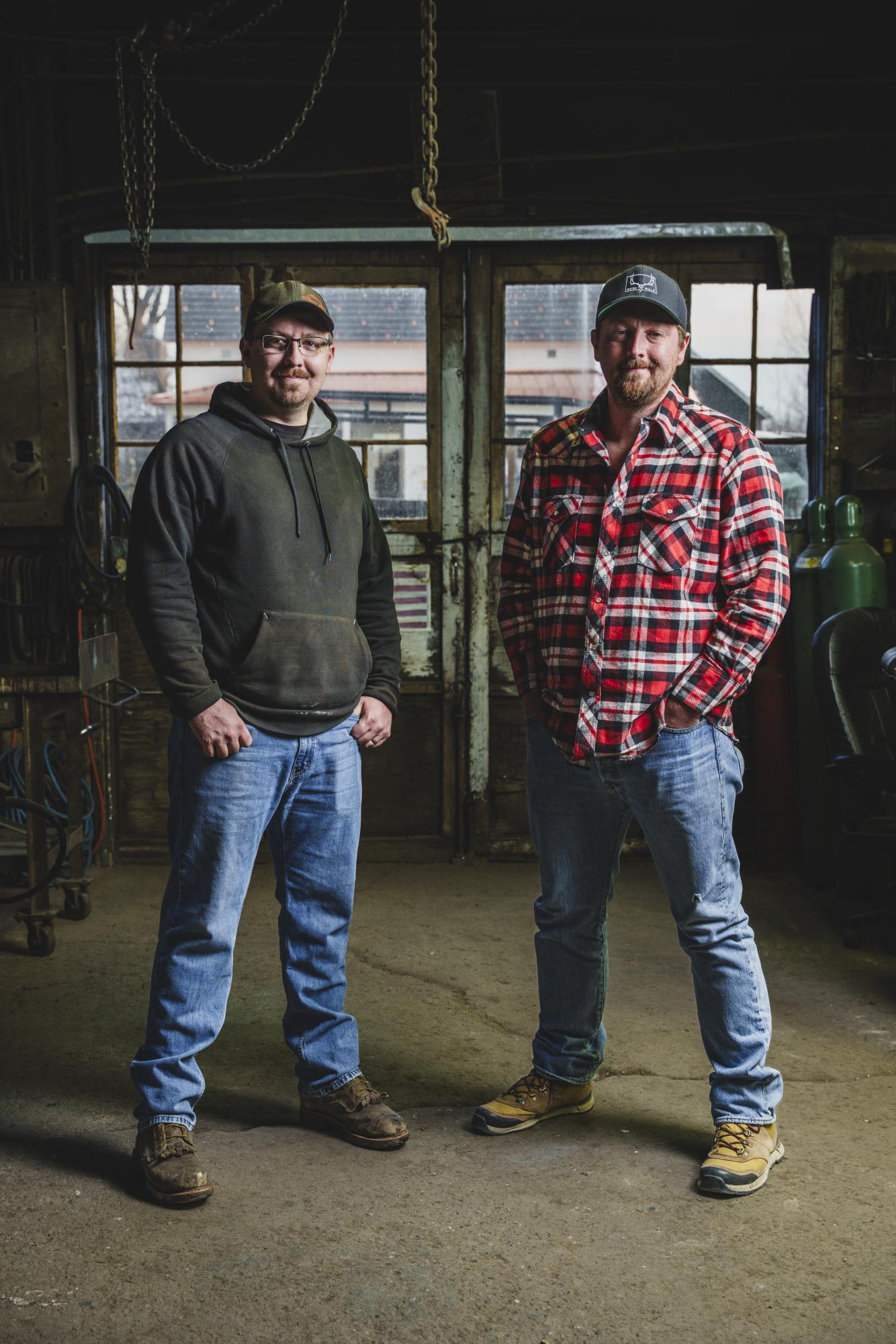
The knives themselves evoke imagery of thunderstorms, wildfires and floods. Of past lives, future triumphs and the unending hunt for elegance and perfection, these knives seem to know. Luke and Cole pour their diligence and love into each and every Damascus blade they craft, and from these spirits comes a product of the highest quality.
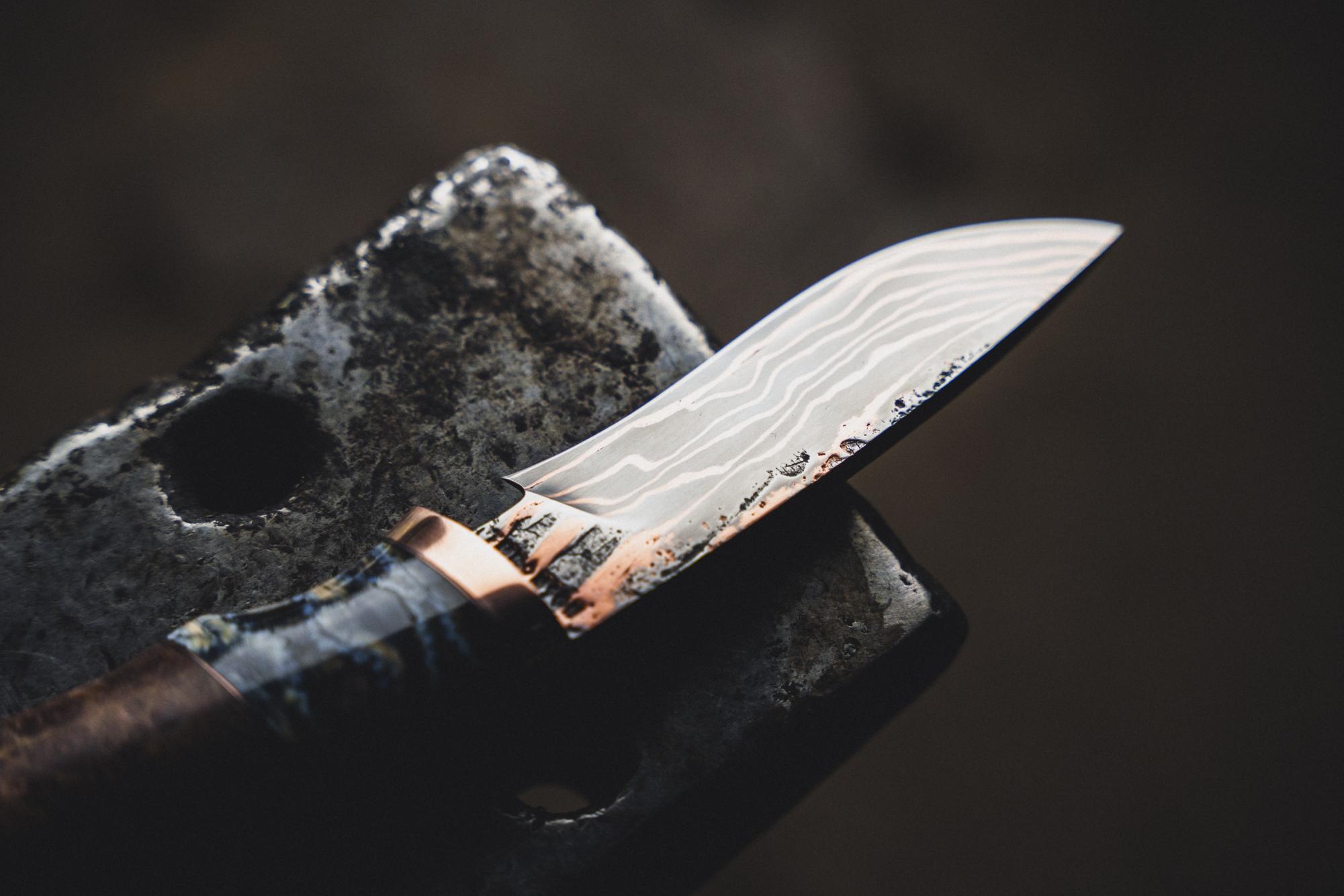
Take, for example, a Cu-Mai Hunter currently for sale on the Thronson Forge website. Over 400 tight folds of steel betray the sheer amount of work put into this blade – their currents pull the eye to a keen edge. A band of copper winds down the cheek, diving into an elaborate handle. Beneath a guard of polished copper, jade green mammoth molar adorns the glossy purple maple burl the brothers chose for this grip. This triadic color scheme lends itself as proof of dedication, the final flourish on top of an already gorgeous blade.
“When I’m making a high-end knife, I’m trying to make it a work of art,” Cole said. “I would say a lot of the people who buy a $1,000 knife aren’t going out and skinning an elk with it, at least I wouldn’t. So we’re trying to make something that you can put on your shelf and talk about, and hand it down to your kids. [But] if you need to use it, it’s one-hundred percent functional.”
A finished Thronson knife looks effortless in its beauty – a polished blade, intricate Damascus patterns and a carefully sculpted handle. But the process behind each knife can take anywhere from 12 to 20 hours of work, and so low a number was hard won.
Long before the Thronson Forge existed, the brothers were kids playing outside. They grew up on an old farm in North Dakota with a large family – nine siblings total. Spending time outdoors was simply a part of life – their days were filled with hunting, fishing, building forts and exploring the woods around them.
“When we were kids, we would make wooden knives,” Cole said. “We did a lot of hunting in North Dakota, that’s about all there is to do. That’s probably when I first got into functional knives.”
As the kids got older, their father made sure they each had their own Buck knife. The early experiences of carving sticks into blades and then using their real knives for hunting and fishing planted the seeds for something much bigger.
Eventually, the family moved west to Montana – a dramatic change. The prairies and flats of North Dakota gave way to the Rockies, meandering rivers became rushing mountain streams and the winters remained brutally cold. The brothers continued their outdoor lifestyle, hiking every weekend, hunting and fishing as they’d always done. Yet the new landscape began to leave its mark.
“There’s something to it,” Luke said. “It’s kind of a western thing.”
Even today, Thronson-branded blades reflect the environment surrounding their creation. Many are shaped to evoke imagery of the animals in the area.
“When I’m making a Bowie knife or a fighter or even a lot of our hunting knives, I kind of try to make it look like a predator, like a wolf,” Cole said. “I prefer when they have a drop point like that… I think that makes it look mean. It looks like some kind of predator bird or something.”
From birds of prey to the unending mountain ridgelines in all directions, the world around the brothers heavily influenced the forms of the knives they make today.
The town of Manhattan, Montana, is rich with history. So too is the very building in which the forge resides. On this site, workers shod the horses that built the town of Hamilton, which was established in 1865, using some of the same tools that are there today. The town was renamed twice before 1911, when the name Manhattan was chosen, and the town was incorporated. Around 1920, the future home of the Thronson Forge operated as a mechanic shop and parts manufacturer for an International Harvester dealership next door.
The years are evident when looking at the building itself. The very floor is a timeline of cement pads stitched together as the place was renovated and expanded over the decades. The wooden walls are weathered, but strong. Some pieces of equipment remain from the early 20th century. And in 2018, the Thronsons bought the building from a neighbor, and Luke and Cole took to their craft.
“We watched ‘Forged in Fire’ quite a bit,” Luke said. “[Knifemaking] was just something that we wanted to try.”
At the start, neither brother had formal training in bladesmithing. Instead, they took a more modern approach to learn their craft.
“We watched YouTube videos and read books,” Cole said. “There are some good books on it. Everything was trial and error in the beginning.”
Early attempts didn’t always go well. The traditional coal forge that the brothers started with made temperature control difficult. Getting the temperature right is critical when making a Damascus knife. Too cold, and the layers of steel won’t fuse together. Too hot, and the blade will melt.
“I would say probably the first five Damascus blades I made were completely melted,” Cole said. “It was pretty discouraging.”
The brothers eventually switched to a propane forge, which allows for better temperature control.
“Those will get, like, as hot as they’ll go,” Cole said. “The ones we have are perfect for forge welding, and I haven’t melted anything since I got one.”
Those early failures were part of the process. Over time, the brothers became masters of manipulating steel into the artfully raveled Damascus blades that now define their work.
“[We] try to do a good job with it,” Luke said. “But it’s definitely been a learning curve.”
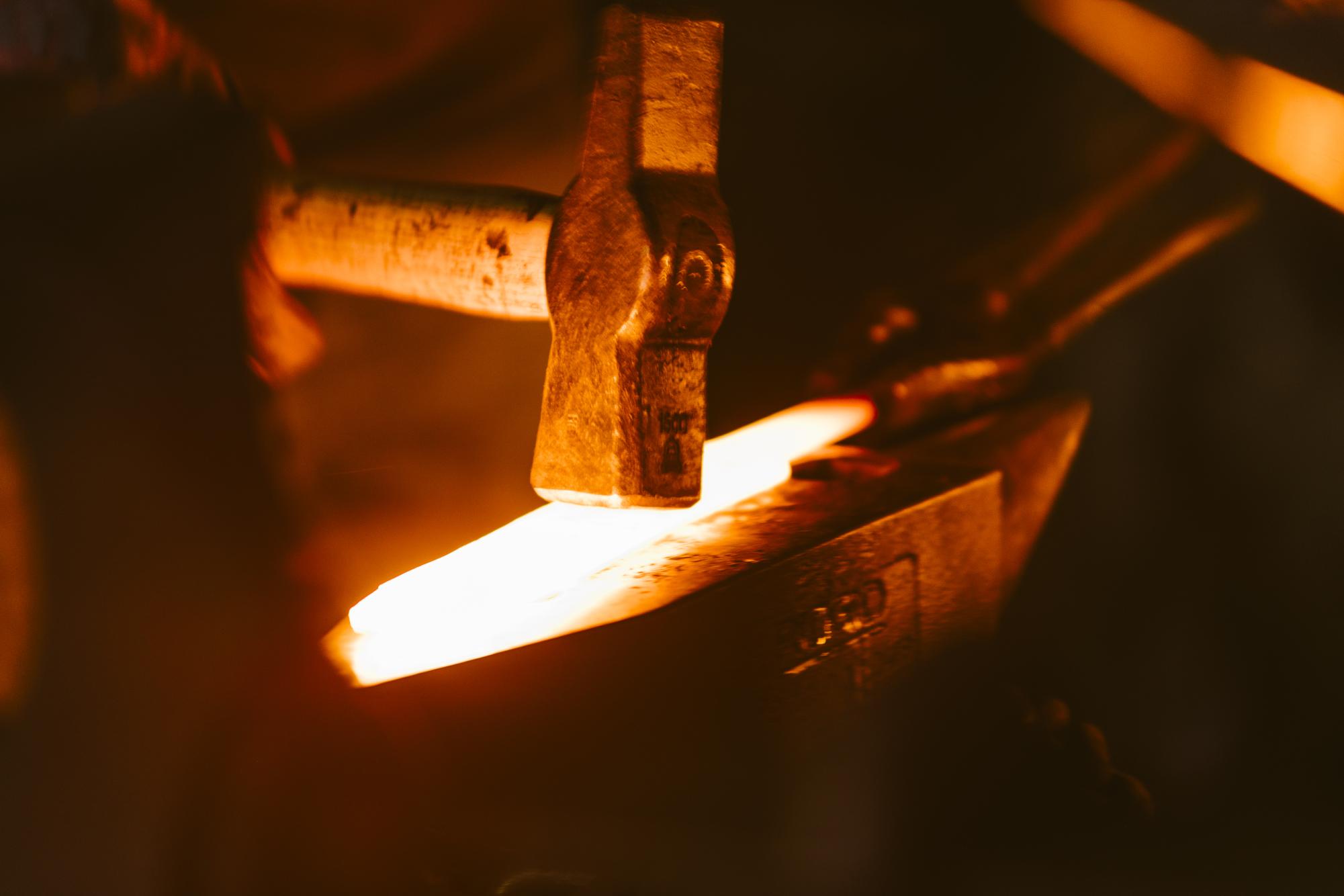
 The brothers start their process by forging billets – thin blocks of layered steel. Many of these billets get sold as they are, but those that don’t will earn a sharp edge and the Thronson name stamped along their side. In one day, enough billets can be forged to make knives for up to five weeks.
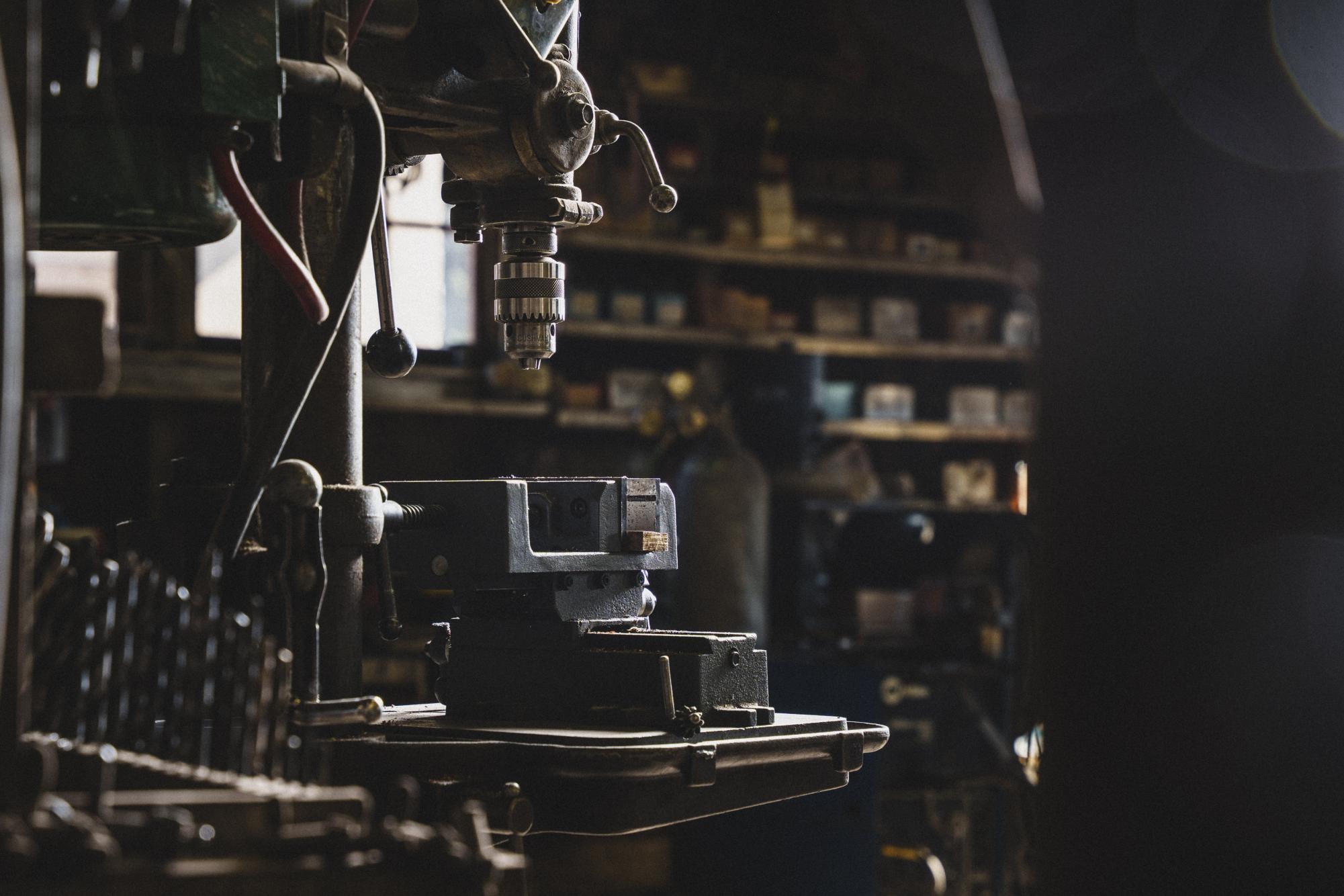
The shape of a knife is then traced onto those billets, and then cut out using grinders. When the rough shape of a knife emerges, these ‘blanks’ are heat-treated in a specialized oven that reaches exact temperatures. Once the blades are heated, they’re quenched – rapidly cooled to harden the steel.
“Once they’re quenched, it takes like four hours to temper them,” Cole said. “So one of us has to be here until later, making sure they get tempered. Then the next day, we would have two batches going, each one step ahead of the other. So if I’m doing this, Luke is getting another billet ready.”
After tempering, the true artistry begins. The blades need to be squared up, then beveled. Grinding these bevels, angling the surface of the knife to form the cutting edge, is one of the most difficult steps. Most knife makers rely on jigs to control grinding slants and achieve an absolutely perfect angle. The Thronsons deliberately chose a harder, more personal path.
“When we first started, we kind of just decided we’re going to either get good at freehand grinding or not make knives,” Cole said. “[The process] goes way quicker if you can just go up and grind it freehand.”
But freehand grinding can come at a cost. Early on, mistakes were frequent and could be devastating.
“I would say we messed up about fifty percent of our knives doing this the first year,” Cole said. “It’s really easy to mess up.”
A slip of the hand, one uneven pass across the grinder or a slight break in attention could ruin hours of work. The steel might get ground too thin, edges warped, balance and symmetry lost. For a craft that is so demanding of precision, errors like these are unforgiving.
But over time, repetition became muscle memory.
“Once you get good at it, though, it’s fast,” Cole said. “You just walk up and grind it, and you’re done.”
This philosophy has come to define the Thronson approach. Learn the hard way, accept the failures and come out the other side with something that is entirely your own.
After the bevels are ground, the blade undergoes one of its most transformative stages – acid etching. Prior to this step, the steel looks almost plain, with a smooth, unremarkable surface. But after a couple of seconds submerged in ferric chloride, hidden patterns emerge in an almost choreographed way, and the surface becomes alive with motion.
This is where that signature Damascus look comes from. The ferric acid eats away at the carbon-rich layers while leaving the nickel untouched. The resulting patterns seem to capture imagery of the wind in the treetops, or the paths of snowflakes as they careen down from the heavens.
“[Some] people actually fake this,” Cole said. “They print it on their blades. But if you etch it deeply, it’s really easy to tell it’s not fake.”
Once etched, the blades need to be neutralized to stop the chemical reaction, using ammonia or baking soda. After neutralization, construction of the handle and finishing can begin.
This is where craft and artistry converge in the most visible way. The Thronsons use a wide and rare range of materials, from stabilized burl woods to fossilized elements that are millions of years old, like mammoth molar and brain coral.
“I really like how much character the burl wood has,” Cole said. “And the mammoth molar adds another layer… it makes it more of a showpiece.”
Each and every handle is carefully composed and limited to a maximum of three colors to avoid overwhelming the eye. The resulting balance of contrast and harmony shows a certain care for their work and certain expectations for themselves to stand out and accomplish more.
Despite their clear, respective eyes for design, the brothers are humble and quick to credit others for refining this aspect of their craft.
“[Adding copper to the knives] was Cole’s idea, or something he wanted to try,” Luke said. “We read about or see what others are able to do, and see if [we] can make something similar, and do a good job on it.”
“My wife does a lot of the critiquing on my color choices,” Cole said. “She’s pretty good at finding what colors go well together.”
His wife, Shayla, is a creator in her own right – an artisan of jewelry. Her influence can be seen in the thoughtful combinations of color and materials that demarcate the forge’s most striking pieces.
Handles are shaped, sanded and polished by hand, which draws out the depth of the materials. Every small detail complements the form; each piece adds to the whole.
“I think my favorite part is finishing up the handle,” Luke said. “When you get to the handle, it’s usually pretty much done. You can see what it’s going to look like.”
From there, the knife is paired with a sheath, which is yet another handmade component. Initially, these sheaths were made by the brother’s mother, who taught them leatherworking, but now the responsibility falls primarily to Luke.
Each sheath is cut, dyed, stitched and finished by hand, without the use of sewing machines.
“It’s pretty rough, actually,” Cole said. “I refuse to do them, [but] Luke seems to enjoy it.”
Luke has embraced the process, completing each sheath with the same attention to detail as went into the blade it holds. These pieces together form a complete object, one that’s functional, durable and beautifully unique.
No knife the brothers make will ever be the same as another. The very nature of the craft makes it so that every piece is unique. And the brothers are not afraid of attempting as many styles as they can – their website shows off Bowie knives, traditional Hunters, Cu-Mai Hunters, Fighters and Japanese-influenced Kiridashi and Tanto.
“We’re trying our best to make them as beautiful and functional as possible, and one of a kind,” Cole said. “[If] someone wants to order one that we’ve already made, we’ll make a replica, but I’m not going to try to make it exact ever. So they are one of a kind.”
As the forge evolved, so too did the brothers’ understanding of what it means to run a business. Their initial approach followed their perfectionist instincts. But time is the hidden cost of any artisanal craft, and spending weeks on any single piece made it difficult to maintain their momentum.
“You can’t spend a week on one knife that only costs $600,” Cole said. “You just have to go with it at some point.”
 Learning to balance efficiency and quality became an important lesson in the brother’s journey. Early on, their focus needed to be on production and getting their knives out there. But the brother’s high standards were with them the entire way, and the Thronson brand stands today as a statement of excellence and continued mastery of knifemaking.
“If [Luke] sees something that isn’t up to his expectations, he’ll tell me,” Cole said. “He’ll say, ‘I’m not putting my name on that.’”
The brothers hold each other accountable, and the forge has become more than just a place of labor. It’s a continuation of those days spent building forts in North Dakota – a collaborative, familial space where each person contributes in their own way.
Other members of the Thronson family occasionally stop by to help with the forging, and the building becomes a gathering place.
“It’s kind of a fun thing to all be able to make knives together,” Cole said.
Family played a critical role in the early days of the business. Relatives bought knives, providing financial support while the brothers were still establishing themselves.
“Starting a knife business is half learning how to make knives and half learning how to sell them,” Cole said. “And selling them might be harder than making them, I’d say. So having a huge family of customers didn’t hurt. We probably couldn’t have done it without them.”
As their skill improved, so did the scale of their work. The brothers built their website and started shipping knives to their customers. And from taking a month to complete a single knife, the brothers now make dozens each year.
“As we’ve been going, we’ve been getting better, faster at it,” Luke said. “The newer ones have been the nicest.”
2025 saw over 75 knives come out of the Thronson Forge, and the brothers are aiming for at least 100 in 2026. Their goal is to continue increasing production while maintaining the quality that defines their blades. Achieving that balance is no small order, but the market is there.
“It’s kind of surprising to me that people keep buying,” Cole said. “There’s a demand for these higher-end… collector’s knives.”
This desire is the result of a broader cultural shift in that there is a renewed appreciation for the handmade in an age dominated by mass production and planned obsolescence.
A Thronson knife represents more than a tool. It is a connection to tradition, craftsmanship and to the hands that shaped it. The name stamped into the steel is a guarantee that each blade met the brother’s exacting standards. This connection is part of why letting go of certain pieces can be difficult.
When a knife turns out particularly well, and everything aligns in material and form, it can be hard to part with.
“Sometimes when you make one really special, it’s actually kind of hard to sell,” Cole said. “[But we know] you’re not just buying a knife, you’re supporting us being able to do what we love.”
Each knife is irreplaceable in a sense. Even if a similar design is attempted, the variation inherent in the material ensures that no two blades will ever be identical. This commitment to uniqueness in their craft reinforces the idea that each knife is not just a product – each knife is a singular creation. And from this, recognition has begun to crop up.
At a knife show in the summer of 2025, a large Bowie knife made with layered Damascus and copper bearing the Thronson name won the award for Best Bowie.
“We took a lot of time to make it nice,” Cole said. “[Winning] was pretty satisfying.”
That Bowie stands as a milestone, a testament to how far Luke and Cole had come from their early days carving wooden blades. And yet they remain humble, ever grounded in their appreciation for everything around them.
“It’s cool to be able to make these,” Luke said. “It’s been cool to work together and to get a system together. It’s nice to be able to work with somebody I get along with.”
The Thronsons have made over 500 knives since they began their journey in 2018. With every knife they make, the brothers learn a little more. Their perspective is rooted in continuous improvement rather than nostalgia – each blade they make is a step forward, without a final destination in mind.
The future of the Thronson Forge is still being envisions growing the business and attending major knife shows, where the competition is fierce, but the opportunity for recognition is limitless.
“There’s a few different ones,” Cole said. “Huge exhibits where you can go and try to sell your knives.”
For his brother, the focus remains more immediate.
“[We’ll keep] trying to make something people want,” Luke said.
The brothers walk the line between ambition and humility, an ever-increasing path defined by vision and execution. They are artists of the undefinable, capturing far more than just the form of a knife with each piece they make. More than that, they are hard-working, persevering human beings doing what they love.
“Some of them are more like art,” Luke said. “But these styles, they’re all functional. Just the fact that everything’s being done by hand, you can see it as it goes. It’s a lot easier to keep track of recognizing errors that you may not catch if you were doing it a different way or something.”
In the end, what makes a Thronson knife special cannot be reduced to a single element or a few simple words.
It is not just the materials, though mammoth molar and handcrafted Damascus steel certainly stand out in a crowd. It is not just the processes or the endless hours spent carefully refining each piece to its full potential. It is not just the environment, rich in its history and natural beauty, nor is it just what lies at the heart of the business – the bonds of kith and kin.
It is the combination of all of these things– family, trials and tribulations, dedication, artistry and the feeling of belonging, of being home. It is the journey of learning, setting ever-higher goals and realizing a dream.
It is the young boys carving wooden knives in the forest, the men reading books and watching forging videos late into the night, the brothers standing side by side at a grinder, learning through mistakes.
It is the decision to do things the hard way, to craft by hand, to strive for excellence. It is the quiet pride in a finished blade, and the reluctance to let it go.
It is the understanding that what they are making will outlast them.
A Thronson knife is not just an object. It is a story forged in steel, retold with every cut made, every use, every generation that holds it and sees the care that went into its making.
And there, in the shadow of the Montana mountains, where fire and steel collide and hammers fall in the warm glow of the forge, the story continues to unfold.