Allen Morris was somewhere between his small hometown in Oregon and the liberal metropolis of Portland when an idea blossomed in his mind. He looked up at the glistening skyscrapers, the lush vegetation greeted his eye with varying shades of green. This wasn’t the city he was born in, but it’s the place he considered home, and its changing before his eyes.
“I was really feeling a little homesick and nostalgic of my Portland days at that point,” Morris said, “I haven’t been back to Portland, I think, at that point, probably close to six years and so many things had changed, which I mean, makes absolute sense.”
While sitting in his office that’s bigger than most dorms on campus, he pointed down at a bookshelf that takes up a majority of the wall. An absurd amount of plants populate the top of shelf, UV lights keep them alive in the basement office, void of natural light. Dozens of binders line the shelves, filled to the brim with archived negatives taken throughout his life.
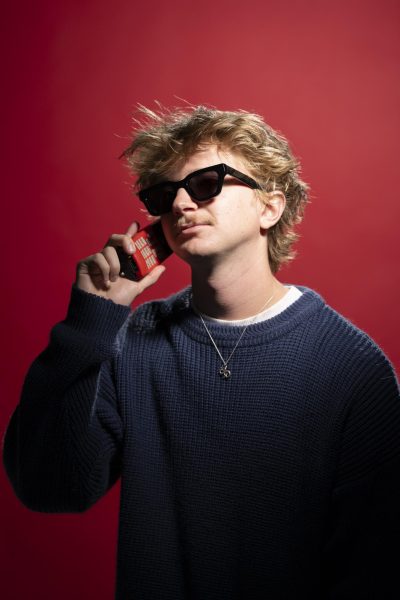
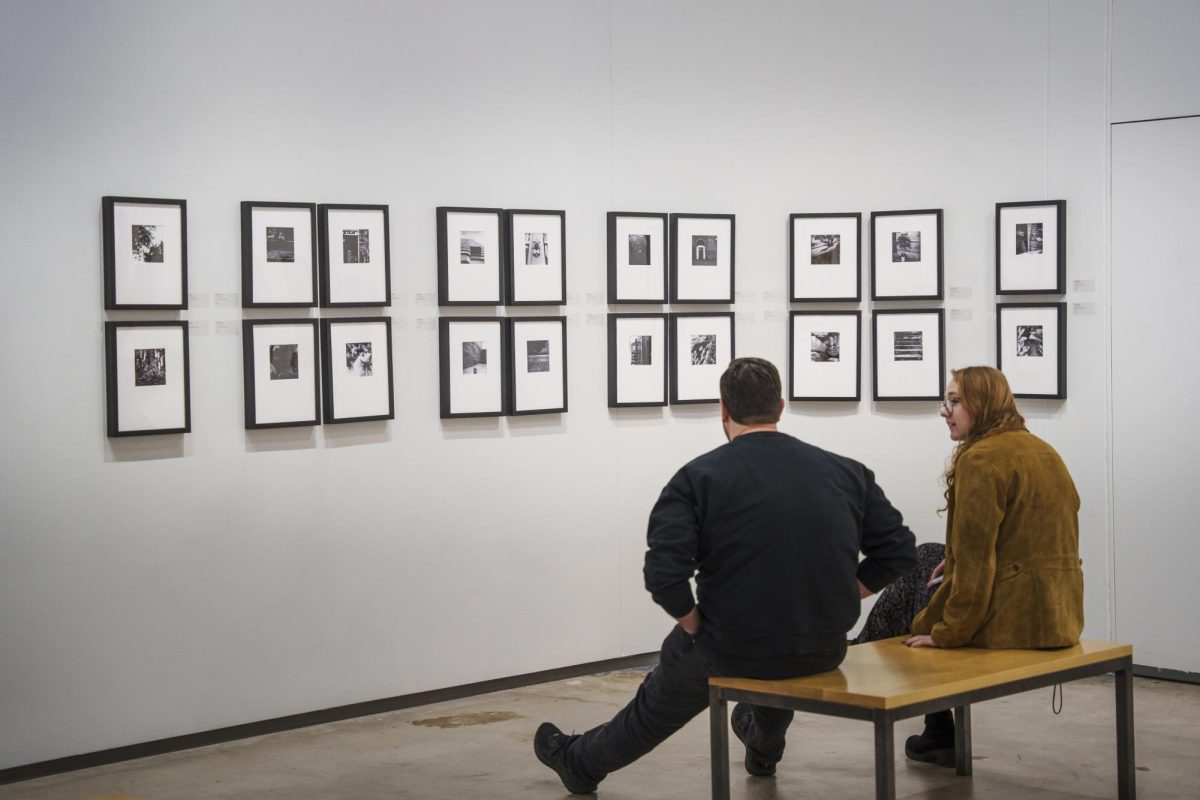
Allen Morris has a charm to him – his round face is full of joy. The desire to help his students in any way possible is felt in his presence. Morris has taught at Black Hills State University (BHSU) for four years as an Assistant Professor of Photography. The series of photos “Keepin’ It” was an idea thought up by Morris while on a trip back to Portland. The photos are on display at the
BHSU Faculty art show at the Dahl Art Center in Rapid City.
High contrast black and white photos shot on a cheap old film camera, called a Holga, occupy the back right corner of the open white gallery at the Dahl Art Center. Each photo is beautifully matted and framed in frames Morris built himself. The series has a melancholic nature. Vintage qualities depict Portland through a sentimental lens. The photos don’t just document Portland. They represent a young man’s memory of the city he considers his home away from home and the changes that come with being away.
“As time goes on, things change and evolve,” Morris said. “I don’t have any right to assume that it won’t, just because I’m not there. In some way, having those photos was kind of keeping it for me in the way that it was when I lived there in 2005-2010-ish.”
Photography was an early passion for Morris. He received his first camera for Christmas from his parents when he was eight and proceeded to blow through ten rolls of film.
“There was nothing really interesting about that, but I think it was kind of cool as practice
and as a method,” Morris said. “I didn’t really do much with it until I was an undergrad, I went to a couple different colleges. The second of my three schools was Eastern Oregon University, where I took a photo class, just for fun. I got hooked.”
After taking that class, Morris transferred one more time to Oregon State University and started pursuing a BFA in photography. While an undergrad, Morris had a strong connection with one of his instructors, Jacinda Russel. Through his experiences with Russel, the idea of teaching someday stuck in Morris’s mind.
“I made an unspoken pact with myself that if I wasn’t happy with where I was with my bachelor’s degree in five years, then I would seriously consider going to grad school,” Morris said.
Morris received his bachelor’s degree in 2005. Five years later, the U.S. was recovering from a global recession. Unemployment was at record highs, with hundreds of thousands of people unemployed. The unemployment rate rose to over 10 percent while banks foreclosed on over three million homes, causing Morris to lose clients.
“They started dropping like flies,” Morris said. “I thought maybe going to graduate school would be a good thing at that point.”
Morris applied to schools around the country, ultimately committing to the MFA program
at the University of Nebraska, Lincoln. While in his five-year pact, Morris found commercial
photography jobs in the Portland area, including dressing up in rugby attire for a commercial photoshoot. After a few years spent in an underwhelming portrait studio similar to what one used to find in a Walmart or J.C. Penny, Morris switched his focus away from commercial photography work to the more artistic side.
“When he applied, I said, ‘Oh, wait, that’s the guy we met in Alaska,’” said Skott Chandler, Associate Professor of Photography at BHSU. “He was very alt-process and film directed, and that was kind of what we were looking for because that was the gap in our staffing at that point.”
Chandler and his now-retired colleague, Jerry Rawlings, met Morris at a photographic conference in Fairbanks, Alaska. The cold, barren landscape providedthe perfect opportunity for the three of them to bond over cheap bar nachos, drinks and a couple rounds of darts. The trip was made all the more memorable after Rawlings was chased by a black bear while trying to light up a cigarette. Morris applied to BHSU and was invited to campus for an interview prior to being hired.
Balancing personal artistic goals while teaching the future generations of photographers proves to be a challenge for most. Not giving in to the temptation to use school resources for personal projects over helping students develop is something Morris takes seriously.
“I think anyone who goes into education, probably at any level, there’s sort of an understanding that you’re never going to get rich doing this,” Morris said. “Getting to hang out with my colleagues and these younger generations, show them really cool things, teach them how to do stuff, and then they show me how they use those skills and techniques to make really great photos. I think that’s the best gig a person could ever have.”
The inviting atmosphere of Morris’s office and the surrounding photo rooms foster a safe place for students to fully embrace their creativity. Alumni’s work covers every wall of the photo classroom. Undergrads fill the seats throughout the day, gaining valuable instruction from the professors as well as fellow students. Room 008 is not only a spot for future creatives to work
on projects and build a portfolio, but it’s also a place for young people to discover who they are, through art.
“The depth of his artistic practice is really impressive, he’s really involved in SPE, been on
leadership of the LGBTQ+ caucus, he’s just a very involved and a very well exhibited artist,” Chandler said. “But he’s a teacher first.”
Being a professor in the comparably underfunded and often underappreciated College of
Liberal Arts stimulate a sense of daily unpredictability.
“I’m always wondering what is going to go down today, what sort of catastrophes am I going to
help solve,” Morris said. “Those catastrophes and conundrums and questions that students bring up for their own work get directly applied to my own work.”
We are a product of where we come from. Along with the verifiable information on a birth certificate, one could only assume when witnessing a young man with a Broncos hat and Broncos bumper sticker on his Subaru Outback that he is a Colorado native.
Morris doesn’t fit neatly into any stereotypes. He is, for lack of a better term, one of a kind.
From his childhood spent in the sparsely populated eastern side of Oregon to his later years spent in the comparatively wild environs of Portland, Morris is both a product of his environments and yet uniquely him. Each of the places he’s called home, however, have rubbed off on him and his artistic practice in some way.
“It took me until graduate school to realize what [my art] was about,” Morris said. “And looking back, it was always there in front of me. I just didn’t really have the vocabulary or the ability to kind of see it for what it was. My work uniformly across all the bodies of work that I made is really about place with a capital ‘P,’ wherever or however you want to look at it, geography impacts who we are and what we become.”
The melancholic images of “Keepin’ It” were printed to maintain memory of Portland that was slowly fading and transforming over time. By putting archived images into a series, Morris solidified the years of his life as a professional as being some of the most influential, not because of the work he was doing, but the place and community he was a part of.
“When you move away from or change your place geographically, it changes your place mentally and psychologically and all of those things,” Morris said. “I’m really intrigued about those ideas, how when you change the stories about the people who you now surround yourself with, you kind of change and you kind of mold yourself to the particular location and that set of humans.”
Much like the locations that influenced him throughout his life, Morris now influences the students that walk through his door, doing anything and everything he can to allow them to reach their full potential.
“I don’t care who they are, what they’re interested in, as long as they’re being supportive,” Morris said. “I will support them through the teeth. I will do whatever I can to help a student say what they need to say.”